Has Go-to-Market Complexity Blunted Managers Ability to Harness the Levers of Growth?
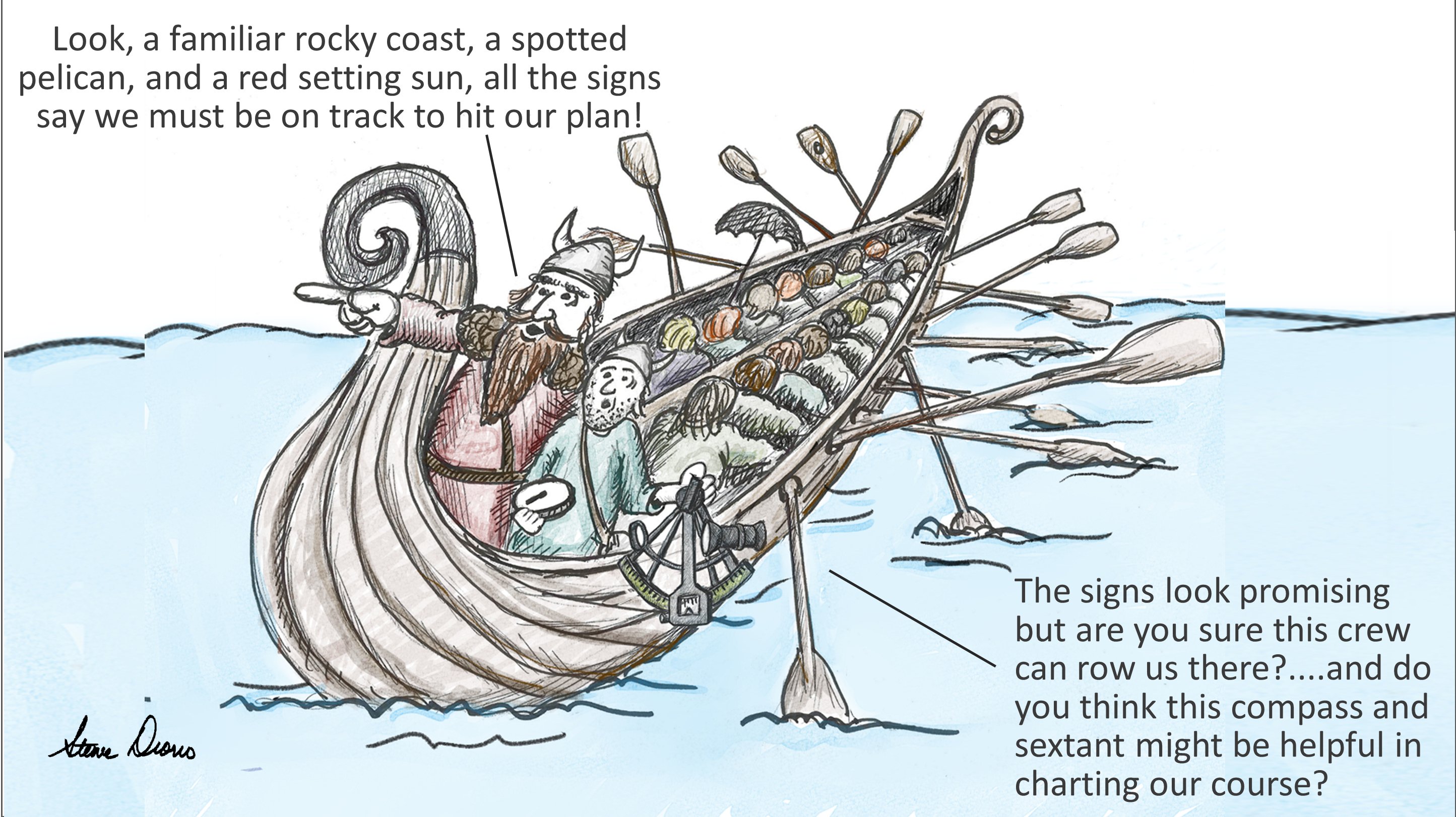
Most mid-market B2B businesses miss revenue targets, and their leaders don’t know why.
Fifty five percent of mid-market companies are regularly missing quarterly revenue forecasts by more than 10% according to Forrester Research. About three quarters (73%) of mid-market businesses failed to meet their growth expectations for 2025, according to a recent survey of 60 CFOs. And over 80 percent of businesses have missed their sales forecast in at least one quarter over the last two years, according to data collected by the sales engagement firm Gong.
These businesses are not underperforming because of bad strategy, product, or sales. The real reason is their owners and leaders have not adapted to the rising complexity of growing a business and are therefore not managing all the factors that actually drive growth. Specifically, a primary reason these businesses are underperforming is because they lack visibility into the 40 underlying operational drivers that determine whether revenue targets will be achieved, according to research from Revenue Operations Associates.
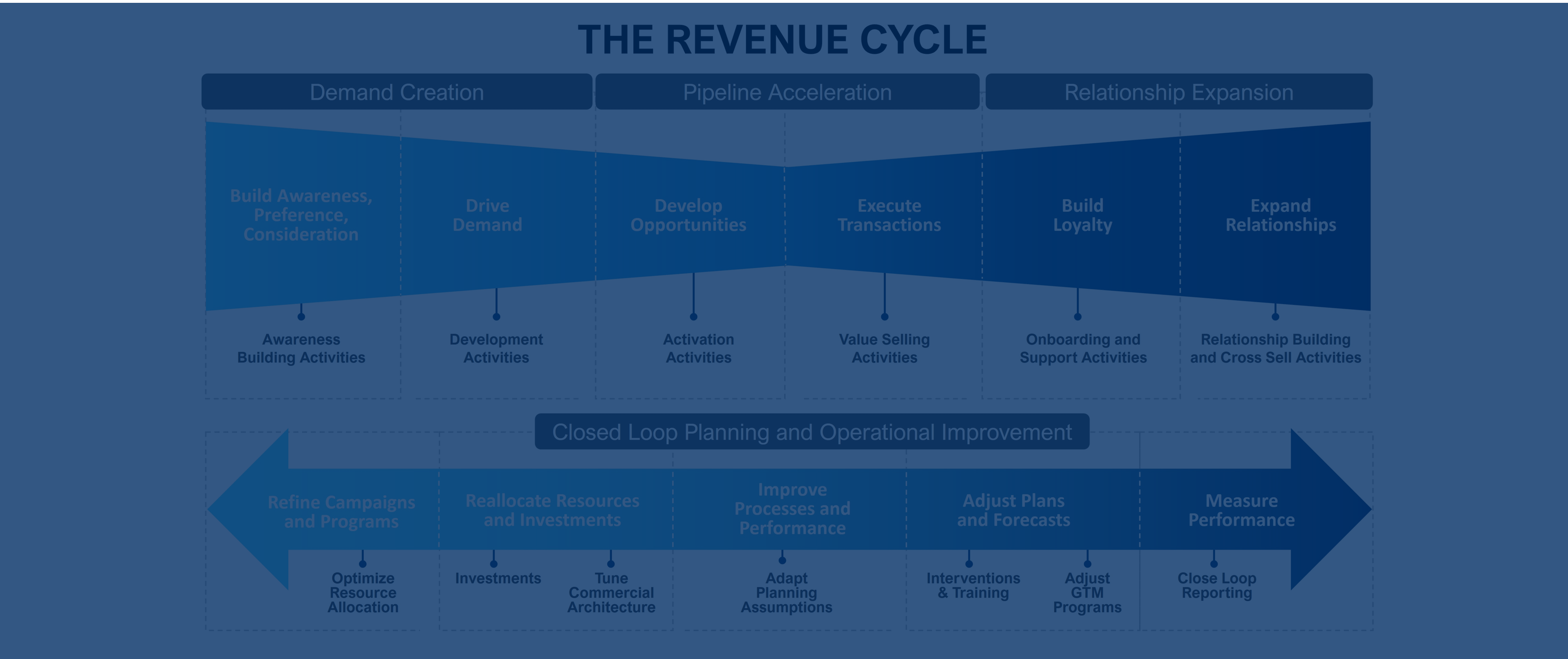
The increasingly complex nature of the modern GTM has blunted managers ability to manage growth in a reliable and capital efficient manner. Over the last several decades, the modern revenue growth game has turned into a technology enabled, data driven team sport that involves dozens of technologies, digital channels, customer data sets, functional teams, and cross functional processes. For example, according to the principles of Revenue Operations, there are 45 gears in the modern GTM engine that need to be connected and managed.
“Revenue organizations are more complex than they have ever been, to a degree that almost no one appreciates or even pays attention to,” according to Dan Frailey, leader of the Chief Revenue Officer Executive Education Program at the University of Chicago Booth School of Business. “If you do the math, the go-to-market of a typical business is literally thousands of times more complex than just a few years ago. This means the growth leaders of that business must make thousands more decisions that impact revenue outcomes which, like it or not, will determine their success."
Management and measurement practices have not kept up. Traditional marketing management, product management and sales leadership from the business school, consulting and management training canon have become increasingly parochial and siloed disciplines. And the PE playbook of financial leverage and combinations fails to create genuine organic growth that business valuations require.
These dynamics mean the ways most owners, CEOs and growth leaders manage, and measure growth are riddled with blind spots and hidden execution gaps. These ‘blind spots’ exists because current financial, operational, and performance reporting approaches don’t adequately factor in the data-driven, asset intensive, and teamwork oriented nature of the modern go-to-market. The Revenue Operations Associates research shows that over half of growth outcomes are created by teamwork across functions not within sales or marketing. Another finding was that growth assets like knowledge and product innovations actually have a much bigger impact on future revenues than the growth actions.
These hidden execution gaps matter because they cost companies millions in lost revenue and unrealized shareholder value. They also put CEOs and CROs at risk when they must explain to their boards why revenue targets are missed. “Unfortunately, the vast majority of GTM leaders have responded to the complexity of growing a business by ignoring it and focusing on what’s familiar,” says Dan Frailey, a three times CRO who is redefining the academic curriculum of growth management. “They unknowingly but quite literally leave their success to chance because they do not know the ‘blind spots’ and how to manage this complexity in a way that drives career and commercial success. And sooner or later their luck will run out - which is a big reason why the average tenure for CROs has fallen recently to only 17 months.” Common ‘blind spots’ not addressed by traditional growth management practices include:
- Inconsistent revenue realization and cash flow because Finance is not involved early enough in the process in critical pricing, planning, forecasting, compliance, cost to sell, and resource allocation decisions. This contributes to three to five percent of revenue and margin leaking due to lack of coordination by finance with the product, deal desk, RFP response, sales, customer success, and billing functions that support the revenue cycle and turn pipeline forecasts to realized revenue and collected cash;
- The inability to turn a wealth of customer engagement data into decision-making knowledge leads to poor decisions about how to allocate growth resources, the best customer actions to drive revenue outcomes, and ways to optimize GTM performance. This is a big problem for the 70% of organizations investing in AI as a primary revenue growth driver because without well-organized data and codified knowledgebases, any hope that AI will improve revenue performance is greatly overstated;
- Diminished customer lifetime value due to lack of coordination between marketing, sales and customer success to identify and monetize cross sell and expansion opportunities. As a consequence, while 73% of B2B revenue originates from current customers, only about 23% of businesses effectively enable their sales teams for these expansion conversations according to Forrester;
- Businesses fail to capitalize on their product innovations in the market due to weak handoffs between product, marketing, sales enablement, sales training, deal desk, proposal, contract management, and RFP response teams which drive 30-40% of B2B revenues. This is a particularly big problem for B2B SaaS businesses, who predominantly rely on product led growth strategies as the backbone for scalable growth;
"CEOs typically don’t have visibility into the true drivers of growth in their business," says Steve Busby, CEO of Revenue Operations Associates, a business that addresses the hidden execution gaps causing a majority of mid-market B2B companies to miss revenue growth targets. "They monitor backward looking activity and outcome metrics - pipeline win rates, revenues, retention. But they don't see the underlying process, alignment, and capability factors that determine those outcomes. So, it’s challenging to fix what they can't see and measure." Busby’s business recently launched The GTM Accelerator, the only diagnostic method that evaluates all of the proven drivers of go-to-market performance and revenue growth. This proprietary method assesses every potential way a business can grow to identify the highest impact actions to improve revenue performance—often without adding headcount or budget.
So, what can you do to avoid these hidden execution gaps and improve your ability to hit your growth plan? “The owners, CEOs and CFOs of ambitious growth businesses need to make sure their targets represent a meaningful way to measure their true growth performance - and ask themselves whether they are pulling all the right growth levers that can quickly and reliably achieve their growth targets,” advises Tyler Drolet, a seasoned CFO with a 40 year track record of building capital efficient businesses by improving growth, profitability and enterprise value on exit at mid-market technology businesses. According to Drolet, the owners, CEOs and growth leaders of these businesses should be asking three questions:
- Are the targets we set and missed a meaningful way to measure our growth performance?
- Are the levers we are pulling the right ones to achieve our growth targets?
- Are there other growth levers we could be pulling that will make an impact?
It is very likely the answer to all three questions is likely no in your business. But it doesn’t have to be.
Are the targets we set and missed even meaningful? Even though organic revenue growth is the primary way firm value can grow, the “science and math of growth” are not very well understood by investors, owners, accountants, and managers. Because of this the conventional pipeline forecasts, financial reporting and operational KPI provide limited view into the complex factors driving organic growth. Among their flaws are their short time frame relative to a long sales cycle, backward looking inputs, inability to measure commercial assets that drive growth. Financial statements do little to reveal the true and latent potential of a business to generate future revenues, margins and positive cash flow. FASB standards don’t require accountants to reveal the inner workings of a company or delineate between growth expenses, investments and assets. Any forward-looking revenue and margin forecasts are often uncertain estimates. Managerial accounting clumps selling costs into big buckets (like SG&A). As a consequence most managers a lack both the understanding and accountability for the growth levers they do measure.
Are the levers we are pulling the right ones to achieve our growth targets? Most CEOs will reflexively jump straight to hiring or firing CROs, adding headcount, changing comp plans, or buying new technology when they miss organic revenue target. But they fail to measure and manage over sixty percent of the factors proven to be causal to revenue growth and GTM performance - things like teamwork across functions and better monetizing commercial assets such as innovations, relationship equity, knowledge, digital infrastructure and brands. If a PE firms owns your business, they will bias towards launch new products, replacing managers (CEOs, CFOs), and buying technology. That failed they resort to their traditional playbook of inorganic growth (buying bolt on companies) and operational restructuring – both of which add to complexity and cost cutting. “Revenue is no longer a number you chase – it’s a system you build,” says Tyler Drolet, who has led 6 sell-side exits of hyper growth technology firms, including: Groove Networks, Blueshift Technologies, Active Endpoint, Qvidian Corporation, Connance, NuoDB, and Medisafe. “In my experience, the most successful growth performance results from a deeper collaboration between the CFO and a CEO and growth leadership to truly understand all the levers of growth and continually adjust and invest on the backside of growth” to lock in product/market fit, improve the reliability of customer acquisition, perfect the formula for customer expansion, and build a process of continuous improvement across the revenue cycle with Marketing, Sales, Service, Product, and Finance.”
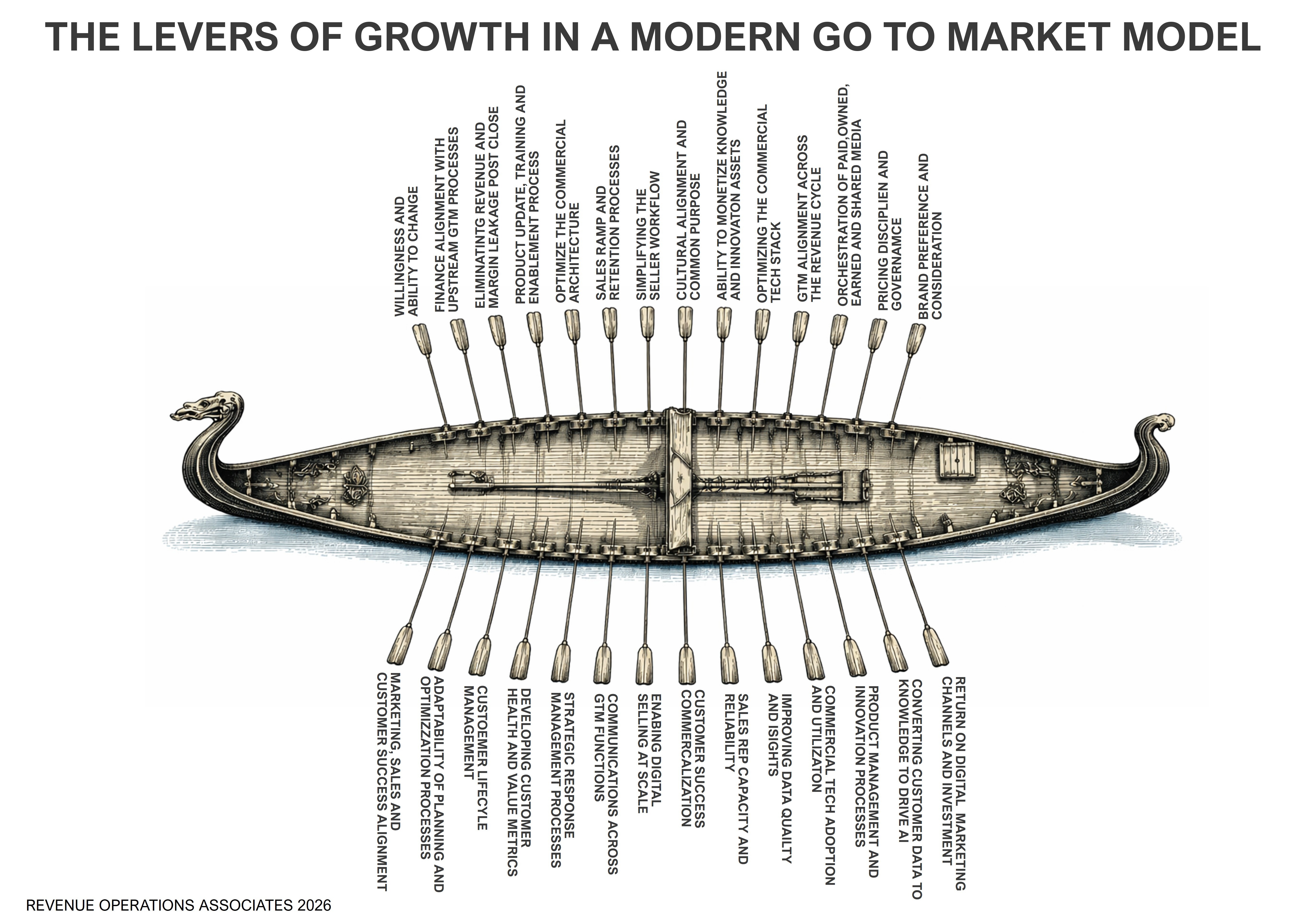
Are there other growth levers we could be pulling that will make an impact? Based on my forty years of GTM strategy consulting experience, business leaders rarely pull all the growth levers that could unlock more revenue with existing resources. They fail to measure and manage all forty of the proven growth drivers to identify and address the true nature and complexity of the modern GTM. The method examines factors that don’t show up in traditional financial and performance reporting like process discipline, cross-functional communications, change readiness, cultural alignment, and technology utilization. For example, few GTM teams have a leader or process aimed at monetizing commercial assets as such as innovations (most SaaS Firms rely on Product Led Growth (PLG) strategies), relationship equity, codified knowledge (over half of firm value), digital infrastructure and brands (over 10% of B2B firm value on average). So, they rarely pull all the growth levers that could unlock more revenue with existing resources.
According to Busby, the GTM Accelerator helps solve this problem because it evaluates all forty proven growth drivers to identify and address all of the root causes of underperformance. The method examines factors that don’t show up in traditional financial and performance reporting like process discipline, cross-functional communications, change readiness, cultural alignment, and technology utilization.
This helps the owners, CEOs and growth leaders of mid-market business get immediate consensus, buy-in and conviction on the best ‘levers’ to improve growth strategy execution and accelerate growth. GTM teams receive clear execution guidance and support so your organization can execute immediately to get growth back on plan. "With a mandate from our PE sponsor to transform i4cp into a scalable, high-growth recurring revenue business, I needed a clear, data-driven assessment of our go-to-market performance and a roadmap for improvement,” reports Terry Waters the CEO of i4cp, a mid-market global research and advisory firm. “The GTM Accelerator process with Revenue Operations Associates delivered exactly that - surfacing the structural and organizational issues that were critical to unlocking growth.”