
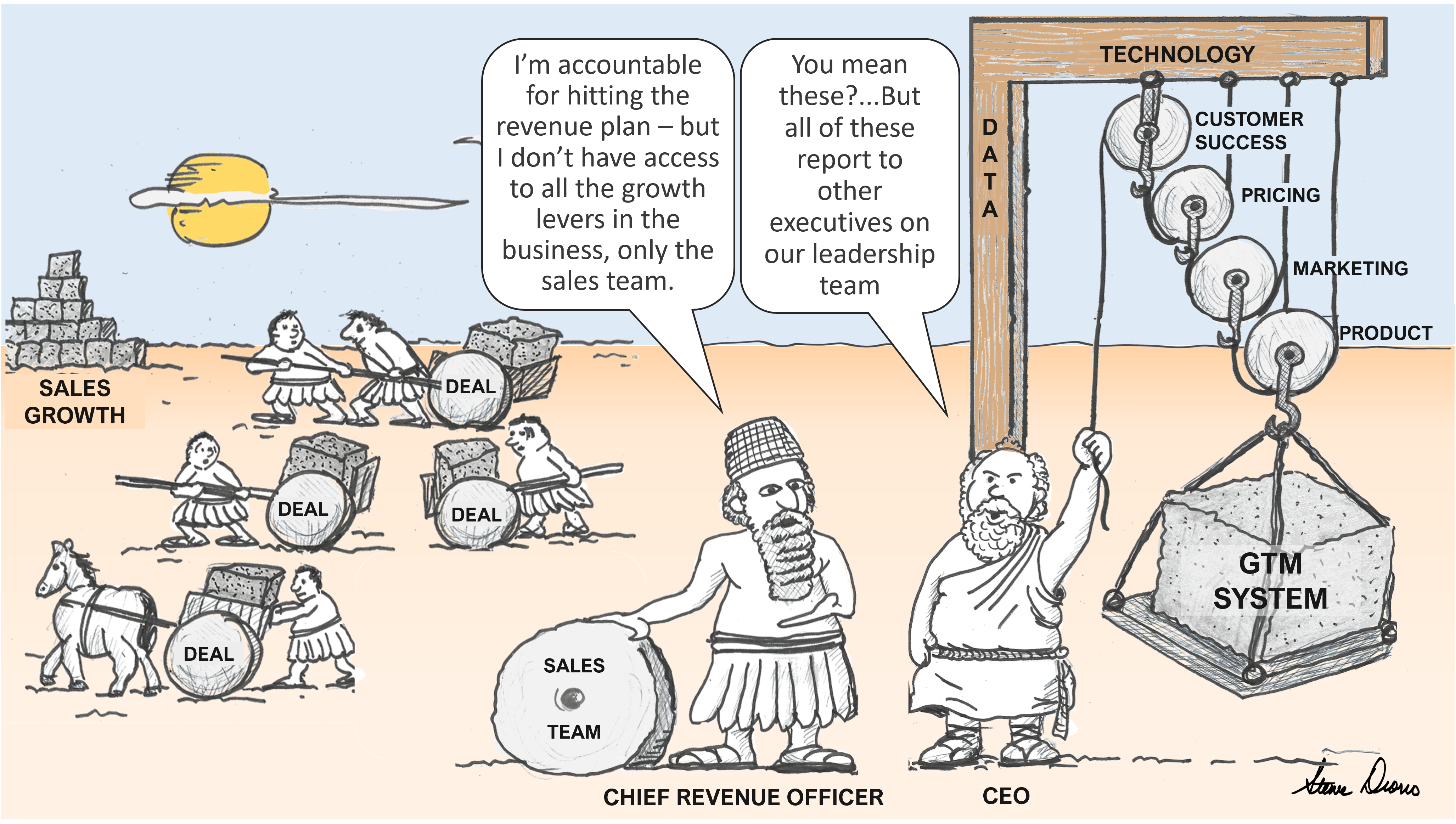
The average CRO/VP of Sales tenure is about 18 months. That's not because revenue leaders are failing - it's because most are set up to fail.
You get blamed when growth stalls. When renewals drop. When quotas are missed. But here's the truth: You own the outcome without controlling many of the inputs that drive it. These inputs are the critical contingencies owned by other parts of the organization – like product, finance IT, and operations.
For example product determines customer needs and sets the roadmap. Finance own setting revenue and profit targets. IT controls the tech stack and user adoption. Ambiguity exists with customer success about who owns retention and expansion. All of these impact revenues and you're accountable for the revenue number, but you're running a race with a team on different tracks.
The Accountability Gap
Sales leaders own clear targets: Revenue growth. Win rates. Quotas. Pipeline velocity. These metrics show up on your scorecard every quarter. Miss them, and your job is at risk.
But if you’re a sales leader without a broad CRO mandate, a trusted strategic RevOps counterpart, and the right KPIs that measure your critical dependencies from other parts of the company, you're not in control and have an accountability gap. This gap includes things that directly impact revenues like: product requirements and release timing, product marketing, technology deployment and adoption, pricing structure, customer success processes that drive retention and expansion, and the data infrastructure that powers your forecasts.
Factors like these can determine whether you hit your revenue number, where the impact becomes visible quickly when you miss targets due to factors you can't influence. For example product delays a critical feature that three major deals depend on. A rigid pricing structure makes competitive deals difficult to close. Customer success lacks the process or skills to drive expansion revenue, so net retention is low. IT rolls out a new AI tool or CRM without a full understanding of requirements or adequate training, so anticipated gains are unrealized. You're undoubtably familiar with situations like these at your company.
Each of these situations are effectively ‘supply chain’ breakdowns that trace back to a dependency you don't control - but you still own the outcome and get blamed. So you're constantly firefighting instead of executing strategy, and in the worst case you're spending time at Board meetings explaining why you missed revenue numbers due to issues nobody wants to hear about because they think your making excuses.
Why The Accountability Gap Happens
Most companies organize GTM functions in silos. Marketing, sales, and customer success have different goals and tracks different metrics. Product, IT, and finance operate independently. Each function optimizes for its own scorecard. Revenue is a team sport but is often played simultaneously on different ballfields, where each function can succeed on paper while revenue misses.
Dependencies between functions aren't typically documented or tracked, so revenue leaders can't see what's broken upstream or downstream until after problems occur. Root causes stay hidden and by the time you spot the problem, it's too late to fix it for this quarter.
The Solution: Build and Communicate the Mandate You Need
Stop accepting an impossible mandate and build the realistic one you actually need. Three steps will get you there.
Step 1: Map Your Complete Revenue Equation
Assess all drivers across your full GTM motion. Not just sales. Include marketing, customer success, product, IT, finance, operations, plus any other requirements that must happen for you to hit your numbers.
The goal is to identify every dependency sales has on all other functions. What needs to happen in product for you to close deals? What lead quality do you need from marketing to hit pipeline targets? What tech capabilities must IT deliver for your team to execute? What expansion revenue must customer success deliver?
Document what needs to happen across the entire revenue cycle for revenue targets to be achievable. Map the entire GTM system, not just the parts you control. If you have a customer journey map, that's a great template to use to flesh out and map your key cross functional dependencies.
This map will give you – and executive management - complete visibility into your revenue equation. You'll be able to see where breakdowns can occur and their impact. You'll have a way to stop finger pointing about why deals are lost and start tracking and discussing the actual root causes.
Step 2: Prioritize Dependencies and Revenue Levers
Not all dependencies (or "levers") matter equally, so you need to prioritize them based on span of control and which ones have the highest revenue impact.
Categorize each high priority dependency or lever into three buckets. 1) You control it directly; 2) You should control it; 3) You are dependent on it (e.g. your critical dependencies from other functions.)
Then define specific KPIs for each critical dependency. Example: On time product launch with zero negative customer impacting issues. Lead quality measured by sales accepted leads. Customer success achieving specific retention or expansion targets. Pricing approvals processed within 24 hours for competitive situations.
The key is to make these dependencies measurable and use them to drive cross functional alignment & teamwork. The right KPIs will give your CEO and Board more clarity and visibility on what drives revenue impact beyond sales reps hitting quota. For example, you can use KPIs to shift from "IT needs to do better" to "IT needs to verify within 10 days that all business requirements were met" (where those business requirement should include zero negative impact on the sales team's ability to sell and zero negative impact on customer experience.) The goal is to be able to make fact based assessments instead of general complaints.
Step 3: Have the Mandate Conversation
Present the complete revenue equation and critical dependencies to your CEO. Show which dependencies and levers drive which outcomes. The key is to highlight the critical dependencies you don't control or have sufficient influence.
Make the case clearly, where the CEO should be receptive since they are tired of playing referee in a game of "he said she said" to decide who is right. They will understand that hitting revenue targets requires teamwork and all functions must do their job for the team to win.
Your opportunity is to define what's required from from each function for the team to win, where you can propose expanded authority over critical requirements or levers. Or you can establish formal measurement mechanisms with clear accountability, using cross-functional KPIs that track dependencies. Both of these will help your odds of long term success and demonstrate your desire for the entire team to win (which will be a shared goal with the CEO.)
This conversation isn't about blame, it's about alignment. You're showing the CEO what it takes for you to hit your revenue number. You're making dependencies visible and the team stronger.
The outcome: Executive alignment on the full revenue equation. Plus clearly defining your authority over critical levers and well defined accountability for dependencies. Selfishly this will help you get protection from blame for factors outside your control and a fighting chance for long term success.
How to Get Started
The GTM Accelerator developed by Revenue Operations Associates provides you with a turnkey framework to execute these three steps.
It assesses your business on the 40 proven drivers of GTM performance and revenue growth across the entire revenue cycle. The evaluation covers GTM performance across marketing, sales, customer success, product, finance, IT, and operations plus key intangibles like culture, alignment, communications, accountability, and data quality. Every core underlying process across each business function that impacts revenue gets assessed.
You get objective data on every part of your revenue equation, with normalized benchmarks that show where the entire revenue team is strong and where gaps exist. Fixing these gaps - especially in areas outside of your direct control - is key to your success.
With the results of The GTM Accelerator assessment, you will have an objective 3rd party way to have a conversation with facts, not opinions, about revenue performance. You'll be armed with the business case for expanding your authority and influence to support what you are accountable for.
Learn more about The GTM Accelerator and how you can use it to drive your career success.